

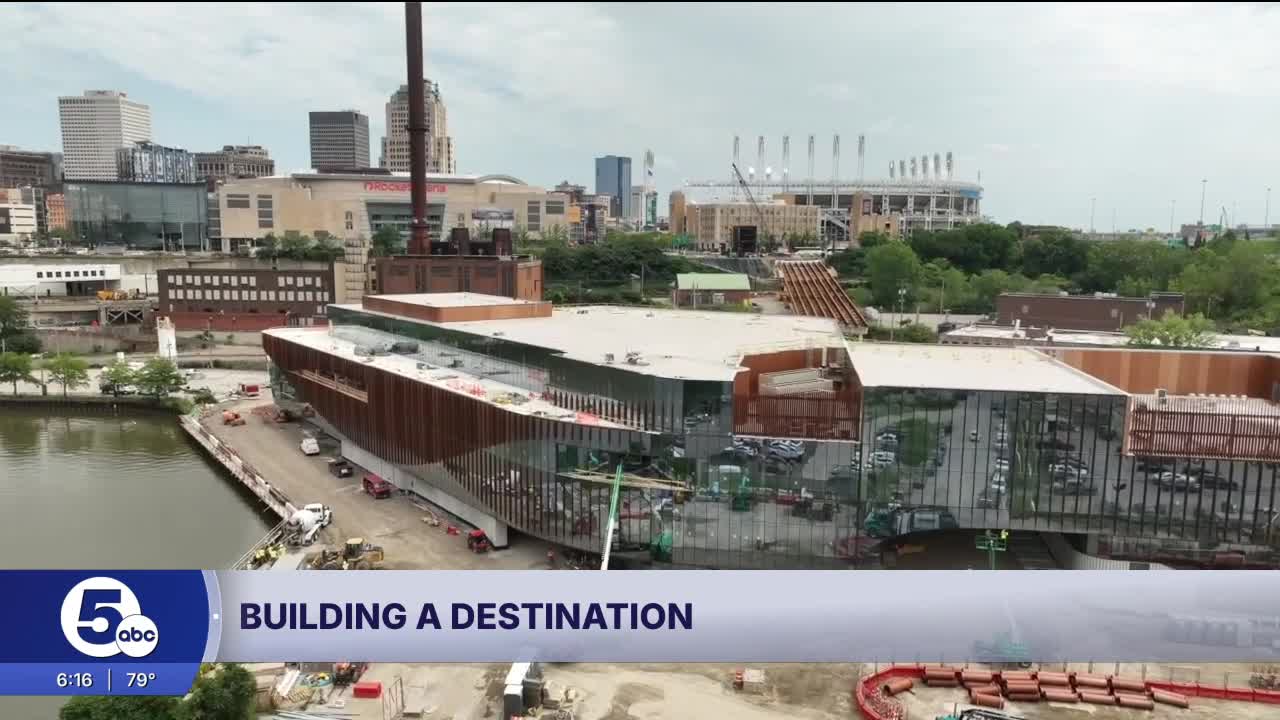



CLEVELAND — The developer behind sweeping plans to remake downtown’s riverfront is nearing a construction milestone on its first building, preparing for a second project — and weighing what makes sense for the balance of a roughly 35-acre site.
Off West Third Street in the Flats, the Cleveland Cavaliers are set to move into their new practice facility in February. Construction on their side of the Cleveland Clinic Global Peak Performance Center will be largely done by the end of this year.
The building is the first piece of an ambitious vision dreamed up by Bedrock, the real estate arm of Cavs owner Dan Gilbert’s empire. Across the street, Bedrock is working with sister company Rock Entertainment Group on plans for a 6,200-seat amphitheater, which will be run by Live Nation. The partners hope to break ground on that project in the fall.
“There’s great cities that have really done well with their lakes and their riverfronts. And we’re coming,” said Antony Bonavita, executive vice president and chief venues and development officer at Rock Entertainment Group.
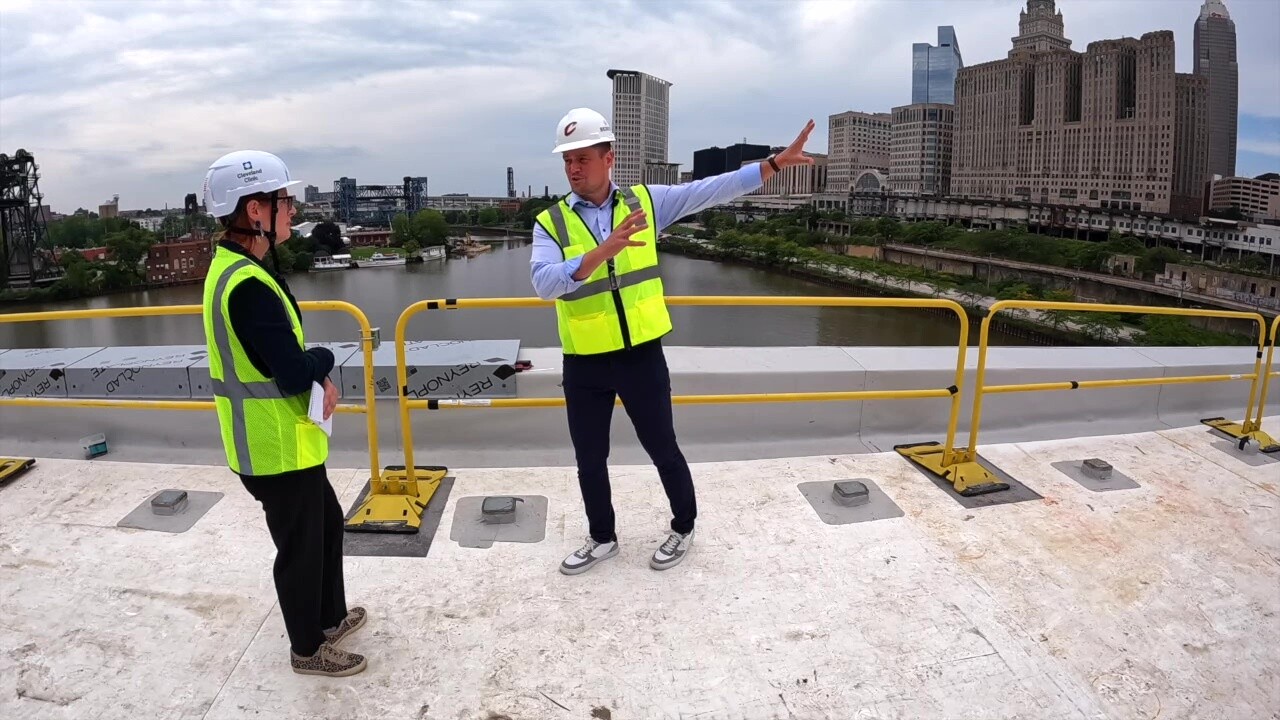
News 5 visited the site this week with Bonavita and Managing Director Dan Whalen of Bedrock, to get a look at progress on construction and a sense of what’s next.
Here’s what we learned.
'A different model'
Officials from the Cavs, the Clinic and Bedrock broke ground for their training and sports-medicine complex in October 2024. The 210,000-square-foot building will be fully open by August 2027.
The Cavs will move into the building during the NBA All-Star Break in February. The downtown center will replace their practice facility in Independence, which is tucked away off Brecksville Road. That suburban complex will be used by the Cleveland Sirens, a WNBA expansion team that Gilbert and Rock Entertainment Group are launching in 2028.
RELATED: The Land's new WNBA team is called the Cleveland Sirens
“Having this be something that people can even come and be a part of is a different model,” Bonavita said of the downtown building. “I wasn’t here when we built the practice facility back in Independence, but the thought process was different.”
The Cavs’ side of the complex will include basketball courts, treatment and recovery areas and places for players, staff and their family members to gather. The project team is still refining its plans for a hospitality space upstairs. On the ground floor, passersby will be able to check out a public lobby filled with memorabilia.
The Clinic controls the other side of the building, where athletes of all ages and skill levels will be able to come for testing, training and treatment. The center will be staffed by professionals in sports medicine, cardiology, pulmonology, genetics and other specialties.
Bonavita said the Clinic facility is scheduled to open in August, once a steep bridge from the Gateway District to the Flats is complete. Bedrock is building a new Eagle Avenue ramp that will stretch from Ontario Street across from Progressive Field down into the Flats. Spanning railroad tracks and tricky terrain, the road will cut through an illuminated tunnel in the center of the building.

“The idea is we want to connect the riverfront with the upper edge of downtown,” Whalen said, pointing to Rocket Arena just up the hill.
That’s no easy task in the area behind Tower City, where Bedrock controls former industrial properties and a sweep of riverfront parking lots.
“You’ve got roads at 100 feet. You’ve got train tracks underneath,” he said. “You’ve got bridges that kind of act as tunnels in certain spots. … You’ve got steam tunnels that go underground from old infrastructure that used to support all these buildings that were built in the 1920s and ’30s.”
That’s a key piece of the puzzle the development team is trying to solve.
“There’s a big lasagna, as I call it, of layers to figure out,” Whalen said.
‘The landing point’
The amphitheater is set to rise on the west side of West Third Street, where Bedrock recently demolished an old industrial building at 401 Stones Levee.
Whalen said the goal is to open the venue in the spring or early summer of 2028.
“We’re really excited about it,” he said, while standing on an upper-level terrace at the performance center. “We think it’s gonna make a statement architecturally. It’s gonna tie in nicely to what this building has to offer. Obviously, it’s going to be the landing point once the Eagle Avenue bridge is constructed and complete.”

The project still needs final approval from the Cleveland City Planning Commission.
During a commission meeting in late July, members of the project team said similar open-air venues in other cities typically host about 40 events from May to October.
Industry onlookers expect the new amphitheater to compete with Jacobs Pavilion, a 5,000-person venue just up the river, on the west bank of the Flats. Live Nation competitor AEG Presents runs Jacobs Pavilion, which opened in the late 1980s.
RELATED: Bedrock plans 6,200-seat outdoor concert venue on downtown Cleveland's riverfront
‘From master plan to real plan’
Whalen said Bedrock’s still figuring out the timeline and trajectory on the riverfront, where the developer plans to install a boardwalk and carve out expansive public spaces.
The next wave of development will probably take place at the other end of the property, where the Sherwin-Williams Co.’s former Breen Technology Center occupies about 10 acres off Canal Road. Bedrock bought that real estate in 2023, and Sherwin-Williams recently moved its scientists, engineers and other employees from downtown to a new research and development campus in Brecksville.
“We’re gonna position, hopefully, both ends of this,” Whalen said of the broader riverfront site. “And then start to tie those threads in together.”
He said Bedrock plans to tear down the old tech center, while preserving the historic Baltimore & Ohio Railroad depot building next door, at Canal and Carter roads.
It’s still unclear what the long-vacant depot will become, or what will ultimately rise on the former Breen Technology Center site. And the company is still sorting through what makes sense for the ailing shopping mall at Tower City. Bedrock owns the retail portion of the sprawling, mixed-use complex, along with some office space and parking there.
“We’re kind of trying to evolve from master plan to real plan,” Whalen said, referring to a $3.5 billion, long-term redevelopment concept the company released in 2022.
RELATED: Bedrock forges ahead on Cleveland riverfront vision
“And so, with just the dynamics of the market … we’ve got to figure out what the right game plan is and what the right pieces are, in the right order,” he said, “in addition to all the infrastructure work that needs to take place to update utilities and roadways.”
In 2025, Bedrock won a $9 million state tax credit to help with site preparations and early phases of the riverfront project. The developer’s tax-credit application mentioned the amphitheater, along with the prospect of a roughly 560,000-square-foot, 17-story building combining a hotel, a live music and entertainment venue, restaurants, retail and parking.
The application said the building would offer guests “a full rock and roll experience,” drawing on Cleveland’s role in rock history and mixing thematic technology, art and décor.
When pressed during an interview, Whalen said Bedrock has “moved away from that particular concept.”
For now, the company’s focused on finishing the performance center and getting the amphitheater out of the ground. There’s still a lot of heavy lifting to do on that portion of the site, from finishing off roads and bridges to demolishing a former steam-heating plant that sits between the practice facility and Rocket Arena up the hill.
Bedrock bought the defunct steam plant off Canal Road in late 2025. It’s attached to an Illuminating Company plant, which the developer doesn’t own.
Whalen said the steam plant could come down in the next year, opening up views to the Gateway District, where Bedrock controls other high-profile properties.
Looking out across the riverfront, he sees a blank canvas.
“Clevelanders, at some points, are their own worst enemy,” he said. “There’s a level of pessimism that kind of underlies, just from lots and lots of years of industrial decay and, obviously, population loss. But we have to be the reason to change that, right? We have to be the ones to provide the shot in the arm.”
Michelle Jarboe is the business growth and development reporter at News 5 Cleveland. Follow her on X @MJarboe or email her at Michelle.Jarboe@wews.com.
