


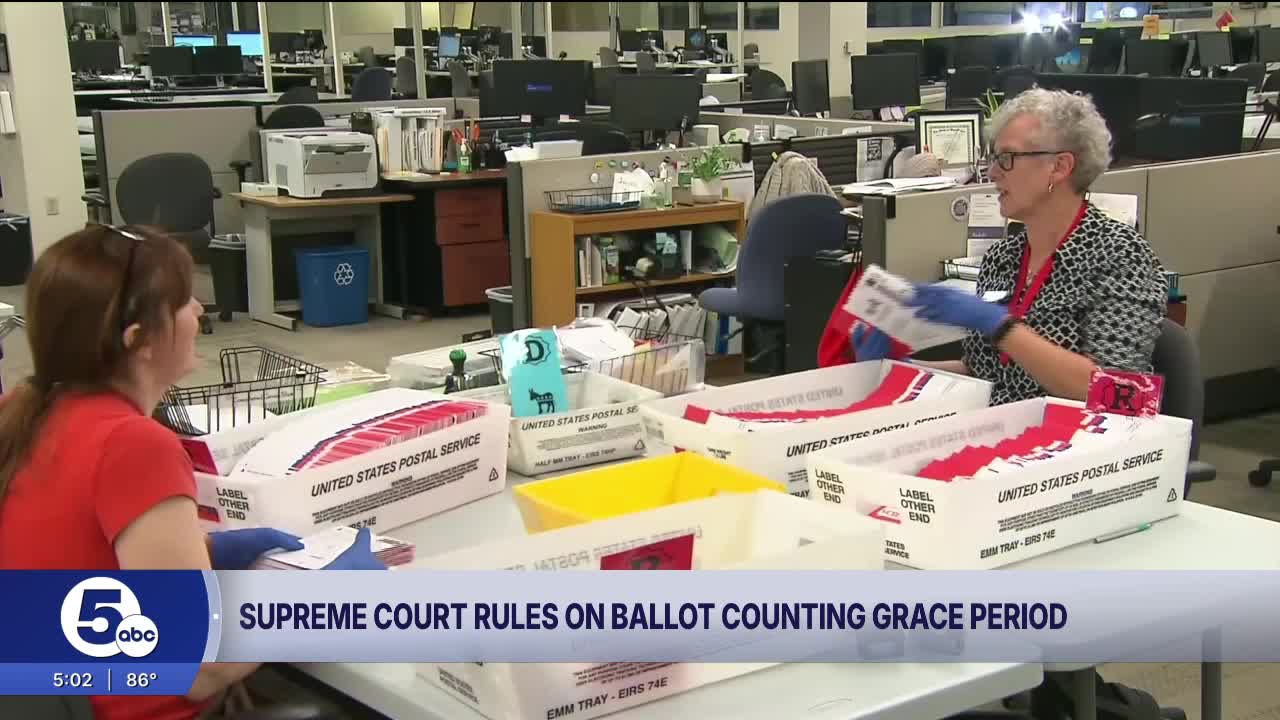



COLUMBUS, Ohio — The U.S. Supreme Court has allowed for mail-in ballots to still be counted even if they are received after polls close, defying Ohio Republicans' expectations. The state GOP lawmakers preemptively passed legislation getting rid of the grace period because they thought SCOTUS would side with them by requiring all votes to be in on election night.
In a 5-4 decision, the justices ruled that states can create their own grace periods for counting votes as long as ballots are postmarked before Election Day. Chief Justice John Roberts and Justice Amy Coney Barrett joined the three Democrats in the deciding vote.
"I'm happy for voters in other states, but I'm disappointed for Ohio voters," voting rights advocate Jen Miller said.
More than 1,500 ballots would have been counted in Ohio’s May primary if state lawmakers had waited for the latest SCOTUS ruling, at least that is how the League of Women Voters of Ohio's Miller sees it.
"This is proof again that the Ohio legislature needs to stop rushing legislative changes to elections," she added.
In the winter, Lawmakers passed a bill requiring ballots to be returned by election night. Up until mid-March, ballots would still be counted as long as they were returned within four days of the election, if they were postmarked before Election Day.
The legislation, Senate Bill 293, has an exception for members of the military and overseas voters.
For years, thousands of mail-in ballots have come in and been counted once polls closed. There were about 6,000 in 2025, and nearly 12,000 in 2024. Those could make or break tight local races, Miller said.
Voting activists begged Gov. Mike DeWine to veto the bill.
"I normally would veto a repeal of this four-day grace period," the governor said in December. "And frankly, that's what I wish I could do."
He signed it, arguing that the high court could decide to require all ballots to be received by election night.
At the time, SCOTUS was debating whether or not ballots could be counted after election day, as the Republican National Committee had sued Mississippi, which had a similar law to Ohio's former law.
"We would have one set of rules for state candidates, one set of rules for federal candidates," he said. "In state elections, their absentee ballot could come in within the four days after the election and be counted, but that would not be true for federal elections."
He was forced to conform to the Supreme Court's possible ruling, he said at the time.
But in the surprise ruling, the justices have allowed for grace periods.
"This decision basically says: States get the power to modernize their elections in order to ensure that all voters can participate, whether they're able to show up in the polls or whether they need to rely on the mail," Case Western Reserve University elections law expert Atiba Ellis said.
Ellis explained this won’t change Ohio law, but it does give a blow to President Donald Trump.
"What this says to the Trump administration is that the court is going to hold the balance created in the Constitution that gives primacy to the states around election laws and a secondary role to Congress to amend those laws as it sees fit," Ellis said.
For years, some GOP leaders have insisted, without evidence, that mail-in ballots can be rigged. Following his lead, red states have started restricting access.
"To have those votes come in afterwards, somebody could try to stuff the ballot box, so to speak, this way if they're in ahead of time, you mitigate that risk of happening," state Sen. Andrew Brenner (R-Delaware) said in an interview Monday.
To be clear, there is no evidence of widespread voter fraud or ballot harvesting in Ohio. Audits done by Republican Sec. of State Frank LaRose continue to prove that.
I asked Brenner if SCOTUS allowing for grace periods helps legitimize these "late ballots" in his book, proving that they aren't inherently fraudulent. He said not any more than Ohio's previous grace period laws.
Brenner created S.B. 293 and wasn't expecting the court's outcome, but stands by the policy.
"I think this will help out with election integrity, and I think it will also help to make sure that we know who wins by election night," he said.
Voting rights groups hope that one day, the law will be reversed.
"Thousands of voters each election will not have their voices heard through no fault of their own," Miller said.
The likelihood that a grace period gets added back in is slim to none under the current General Assembly and GOP leadership.
"Requiring mail-in ballots to be received by Election Day is good public policy shared by 35 states, including Ohio. While today's Supreme Court decision upheld the principle that states largely govern their own elections, they also made it clear that Congress has the right to clarify this policy in federal law, and they should do that," LaRose's spokesperson Ben Kindel said.
Brenner added that he would like to shorten the voting timeline even further.
"You've got this long stretch of period where voters who may vote early, there might be a change in that 30-day window and may end up turning around and regretting their vote after they've already cast it," Brenner said. "I think having it closer to election day is appropriate."
DeWine would likely not sign any legislation that does that. Previously, the governor has expressed his dissatisfaction with lawmakers for their continuous changes to election laws. He recently vetoed legislation that would have required voters to provide their photo ID to cast a mail-in ballot.
I asked the governor's team if he regretted signing the bill, and on the phone, spokesperson Dan Tierney said he made the best decision with the knowledge he had at the time.
"Governor DeWine was required to act on S.B. 293 in December 2025. He could not wait to see what future decisions of the Supreme Court of the United States would be before determining whether to sign the bill. Ultimately, the chaos and voter disenfranchisement that could have occurred if today’s decision went another way were too much of a risk not to have clear standards," Tierney said in an additional statement.
RELATED: Will Ohio Republicans override Gov. DeWine's voter photo ID veto?
Follow WEWS statehouse reporter Morgan Trau on Twitter and Facebook.
